Looking for the LAMB Meaning in Text because you came across it in a message and weren’t sure what the sender meant? You’re not alone, as short words and abbreviations can sometimes have different meanings depending on the conversation.
In texting, social media, and online chats, LAMB may be used in ways that are not immediately obvious. The meaning can also change based on the context, tone, or platform where you see it.
Understanding the right meaning can help you avoid confusion and respond appropriately. In this guide, you’ll discover what LAMB means in text, along with its possible interpretations and examples. Let’s explore the meaning of LAMB and see how people commonly use it in everyday conversations.
Meaning & Definition of Lame in Text
The most common lame meaning in text is boring, uncool, disappointing, weak, or unimpressive.
Unlike many texting abbreviations, lame is not normally an abbreviation made from several words. It is an ordinary English word that has developed a strong informal and slang meaning in online conversations.
When someone calls something “lame,” they usually mean that they do not find it interesting, exciting, funny, impressive, or worthwhile.
For example:
“That party was so lame.”
This means the person thought the party was boring or disappointing.
Another example is:
“You’re lame 😂”
Depending on the relationship between the people, this could be a playful joke rather than a serious insult.
What Does Lame Mean in a Text Message?
In texting, lame can have several closely related meanings:
- Boring
- Uninteresting
- Uncool
- Disappointing
- Weak
- Silly
- Unimpressive
- Poor-quality
- Not exciting
The tone matters. If a close friend says, “You’re so lame 😂,” they may simply be teasing you. However, if someone says, “That was a lame excuse,” they are probably criticizing the excuse.
Examples of Lame in Texting
Example 1:
“Why didn’t you come to the game?”
“I had to study.”
“Lame excuse 😂”
Here, lame means weak or unconvincing.
Example 2:
“Are you going to the concert?”
“No, I have work tomorrow.”
“Lame 😭”
In this context, the speaker is probably teasing the other person for missing the concert.
Background & Origin of Lame
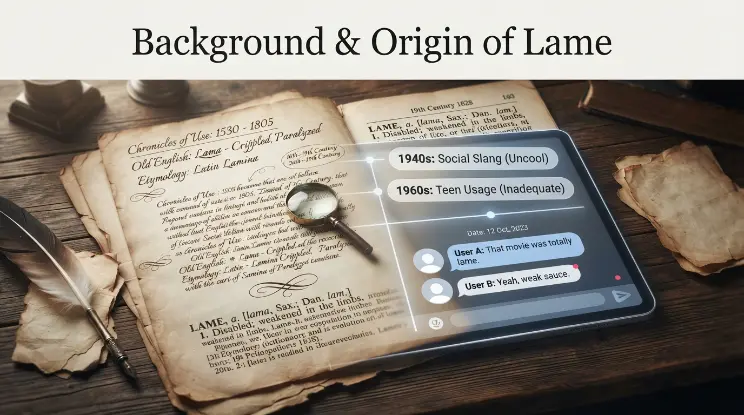
The word lame has a much older history than modern texting and social media. It originally had a physical meaning associated with difficulty walking or having an injured or impaired leg.
Over time, English speakers began using the word figuratively. By the 20th century, lame could describe something weak, ineffective, inadequate, or unsatisfactory.
Its informal meaning became especially common in American English. Eventually, the word became strongly associated with things that were considered boring, uncool, disappointing, or socially unimpressive.
The rise of online communication helped spread this informal usage even further.
People started using short expressions such as:
- “That’s lame.”
- “So lame.”
- “Don’t be lame.”
- “What a lame excuse.”
- “That joke was lame.”
Because texting encourages quick and casual communication, lame became an easy way to express disapproval without writing a long explanation.
Social media, memes, gaming communities, messaging apps, and online forums have also helped keep the term popular.
Usage in Different Contexts
The meaning of lame can change slightly depending on where and how it is used.
Lame in Texting or Chat Messages
In personal messages, lame usually means boring, disappointing, uncool, or weak.
Example:
“You canceled again? That’s lame.”
The person is saying that the cancellation was disappointing.
Another example:
“He told the same joke three times. So lame 😂”
Here, lame means unfunny or annoying.
Lame on Social Media
On platforms such as Instagram, TikTok, Snapchat, and X, people frequently use lame in comments, captions, replies, and memes.
For example:
“That challenge is lame.”
This means the person thinks the challenge is boring or unimpressive.
Someone might also comment:
“Lame 😂”
This can be a short reaction to a post, joke, excuse, or opinion.
Because online conversations often lack facial expressions and vocal tone, emojis can help indicate whether lame is being used seriously or playfully.
Lame in Professional Settings
The word lame is informal and generally should not be used casually in formal professional writing when you mean “unsatisfactory” or “unconvincing.”
For example, instead of writing:
“That is a lame explanation.”
A professional message would usually say:
“That explanation is not sufficiently convincing.”
However, colleagues may still use lame in informal workplace chats:
“That meeting was pretty lame.”
Here, the speaker means that the meeting was boring or unproductive.
Platform-Specific Meanings
| Platform | Common Meaning | Example Use |
| Boring, weak, disappointing, or uncool | “That excuse is lame 😂” | |
| Unimpressive, boring, or uncool | “Lame post tbh.” | |
| TikTok | Boring, unfunny, or not entertaining | “This trend is lame.” |
| Snapchat | Playful criticism or teasing | “You’re lame 😭” |
| Twitter/X | Weak, disappointing, or unimpressive | “That argument is lame.” |
The basic meaning remains similar across these platforms. The surrounding conversation determines whether the word sounds humorous, sarcastic, friendly, or critical.
Other Fields Using the Word Lame
Although lame is very common as informal slang, it can appear in several other contexts.
Everyday English
The ordinary conversational meaning can refer to something boring, weak, or disappointing.
“That was a lame excuse.”
Entertainment
People may call a movie, song, joke, game, or event lame if they find it boring or poorly executed.
“The ending was lame.”
Gaming
Gamers may use lame to criticize a strategy, game mechanic, opponent’s behavior, or gameplay.
“Camping the whole match is lame.”
Workplace Communication
In informal workplace conversations, someone may describe an activity as lame when it feels boring or disappointing.
“The office event was kind of lame.”
Older Literal Usage
Historically, lame also had a physical meaning connected with difficulty walking or physical impairment. This older meaning is different from the modern slang use and can be sensitive depending on how it is used.
For modern communication, it is important to understand the surrounding context rather than automatically assuming the slang meaning.
Common Misconceptions & Mistakes
One common mistake is assuming that lame always means “bad.” Although it can communicate criticism, it can also mean boring, uncool, weak, disappointing, or simply not enjoyable.
Another mistake is assuming that calling a person lame always means the speaker seriously dislikes them.
For example:
“Bro, you’re lame 😂”
Between close friends, this may be playful teasing.
But:
“You are lame and nobody wants you here.”
This is much more openly insulting.
Lame Does Not Always Mean Uncool
Sometimes lame means weak rather than uncool.
“That was a lame excuse.”
The speaker is criticizing the quality of the excuse rather than someone’s personality.
Lame Does Not Always Mean Boring
Consider:
“That joke was lame.”
This may mean the joke was predictable, unfunny, weak, or poorly delivered.
Context Changes the Tone
Compare:
“Lame 😂”
with:
“That was a lame thing to do.”
The first may be playful. The second sounds more critical.
Similar Terms & Alternatives
Several words can communicate a similar idea to lame, but they are not always interchangeable.
| Term | Meaning | Example |
| Boring | Not interesting or exciting | “The movie was boring.” |
| Uncool | Not socially appealing or fashionable | “That outfit is uncool.” |
| Weak | Not convincing or effective | “That was a weak excuse.” |
| Dull | Lacking excitement | “The conversation was dull.” |
| Cringe | Embarrassing or awkward | “That video was cringe.” |
| Bad | Generally negative or poor | “That was a bad idea.” |
| Disappointing | Not as good as expected | “The ending was disappointing.” |
| Cheesy | Overly sentimental or cliché | “That line was cheesy.” |
| Unimpressive | Failing to create a strong impression | “His performance was unimpressive.” |
The closest alternative depends on the sentence.
For example, lame and boring can overlap, but “lame excuse” usually means a weak or unconvincing excuse rather than an uninteresting one.
How to Respond to Lame Chat Examples
Knowing the meaning is only half the challenge. You may also wonder how to respond when someone calls something or someone lame.
Conversation 1: With a Friend
Friend:
“You’re not coming tonight? Lame 😂”
You:
“I know 😭 I owe you one!”
Here, lame is clearly playful.
Conversation 2: Online Chat
Person A:
“That movie was lame.”
Person B:
“Really? I actually enjoyed it 😂”
The second person disagrees without making the conversation unnecessarily serious.
Conversation 3: Colleague
Colleague:
“They canceled the team event. Lame.”
You:
“Yeah, I was actually looking forward to it.”
Here, lame expresses disappointment.
Other Short Responses
Depending on the situation, you can respond with:
- “Haha, fair 😂”
- “Why do you think that?”
- “I disagree.”
- “Seriously? I thought it was good.”
- “I know, right?”
- “Okay okay, my bad 😭”
Differences from Similar Words
The meaning of lame can be confused with several other negative words.
Lame vs Boring
Boring specifically focuses on a lack of interest or excitement.
“The lecture was boring.”
Lame can mean boring, but it can also mean weak, uncool, disappointing, or unimpressive.
“That excuse was lame.”
Lame vs Cringe
Cringe usually describes something embarrassing, awkward, or uncomfortable to watch.
“That video was cringe.”
Lame is broader.
“That video was lame.”
The second sentence could mean boring, weak, disappointing, or simply not enjoyable.
Lame vs Weak
Weak can describe something lacking strength, effectiveness, or convincing power.
“That argument was weak.”
Lame can have a similar meaning:
“That argument was lame.”
But lame is more casual and can also carry the idea of something being uncool or disappointing.
Lame vs Disappointing
Disappointing focuses on something failing to meet expectations.
“The concert was disappointing.”
Lame can communicate the same reaction but sounds more informal.
Relevance in Online Conversations & Dating Apps
The word lame appears frequently in casual online conversations because it is short and emotionally expressive.
Dating apps are another environment where informal language matters. A person might write:
“Ghosting is lame.”
Here, they are expressing a negative opinion about ghosting.
Someone might also say:
“Your pickup line was lame 😂”
That does not necessarily mean the conversation is over. The emoji may make the comment playful or teasing.
Another example:
“You think dinner at 5 PM is romantic? That’s lame 😭”
The speaker may simply be joking about the suggestion.
When someone uses lame on a dating app, look at the surrounding messages, emojis, relationship between the speakers, and overall tone before interpreting it as a serious insult.
Popularity & Trends Over Time
Unlike newer internet abbreviations, lame did not originate with texting or social media. It was already established in everyday English long before smartphones and social platforms became popular.
However, online communication has helped make the slang meaning highly visible.
Memes, reaction posts, comment sections, gaming communities, and short-form videos frequently use expressions such as:
- “That’s lame.”
- “So lame.”
- “Don’t be lame.”
- “Lame excuse.”
- “That was lame 😂.”
Search interest can also vary depending on entertainment trends, viral phrases, memes, and online conversations. Google Trends can show changes in search interest over time, but a rise or fall in searches does not necessarily mean that the underlying word has become more or less common in everyday speech.
Why Context Matters When You See “Lame”
Text communication removes many clues that are available in face-to-face conversations.
When someone says:
“You’re lame.”
You cannot hear their voice or see their facial expression.
They could be joking with a friend, criticizing someone’s behavior, or genuinely insulting them.
Look at these clues:
Emoji:
“Lame 😂” is often lighter than “Lame.”
Relationship:
Close friends may use the word as playful teasing.
Previous messages:
If the conversation has been humorous, the word may not be serious.
Subject:
“Lame excuse” usually means weak or unconvincing.
Tone:
A harsh or hostile conversation makes a negative interpretation more likely.
Understanding these factors helps prevent unnecessary misunderstandings.
FAQs About Lame Meaning in Text
1. What does lame mean in text?
In texting, lame usually means boring, uncool, disappointing, weak, or unimpressive. The exact meaning depends on the conversation and tone.
2. Is calling someone lame an insult?
It can be. However, friends often use lame playfully to tease each other. An emoji such as 😂 can make the message sound less serious.
3. Does lame mean boring?
Sometimes. Lame can mean boring, but it can also mean weak, disappointing, unconvincing, or uncool.
4. What does “that’s lame” mean?
“That’s lame” usually means “That is boring,” “That is disappointing,” “That is weak,” or “That is not cool.” Context determines the intended meaning.
5. What does “you’re lame 😂” mean?
When followed by a laughing emoji, “you’re lame 😂” is often playful teasing between friends. However, the relationship and surrounding conversation should be considered.
Conclusion
The most common lame meaning in text is boring, uncool, weak, disappointing, or unimpressive. Unlike a typical texting abbreviation, lame is a regular English word that developed a popular informal and slang usage long before modern social media.
You may see it in WhatsApp messages, Instagram comments, TikTok discussions, Snapchat conversations, gaming chats, dating apps, and casual workplace messages.
The most important thing to remember is that lame does not have one fixed emotional tone. “That movie was lame” may express genuine disappointment, while “You’re lame 😂” could simply be friendly teasing. Always consider the sentence, relationship, platform, emojis, and surrounding conversation before deciding what the sender means.

I am William Scott, a passionate content creator and enthusiast dedicated to making complex topics simple and easy to understand. I focus on delivering valuable, well-researched, and engaging content that helps readers find clear answers quickly. I enjoy writing about digital trends, language meanings, and practical knowledge that adds real value to everyday learning.