When you see the word emphasized in a text message, you might wonder what it means and why someone used it. Emphasized Meaning in Text refers to giving special importance or extra attention to a word, phrase, or idea during a conversation.
People often use emphasis in texting, social media comments, and online chats to express strong feelings or make their message clearer. It can show excitement, seriousness, frustration, or highlight something important.
For example, someone might write “I REALLY mean it” to make their feelings more noticeable. The meaning of emphasis can change depending on the conversation and the words used. Understanding this term can help you interpret messages correctly and avoid confusion when chatting with friends or others online.
Meaning & Definition of Emphasized in Text
The word emphasized means that something has been given extra importance, attention, or stress. When a word, phrase, or sentence is emphasized in text, the writer is drawing the reader’s attention to that specific part of the message.
In digital communication, emphasis can be created in several ways. A person might use bold text, italics, CAPITAL LETTERS, quotation marks, emojis, repeated words, or special formatting to make something stand out.
For example:
“I said TODAY, not tomorrow.”
The capitalized word “TODAY” receives extra attention. The sender is making the timing particularly important.
Another example is:
“That was really unexpected.”
The italicized word “really” adds extra emotional stress to the sentence.
Therefore, the emphasized meaning in text is generally connected with importance, stress, focus, or emotional intensity.
What Does Emphasized Mean in Simple Words?
In simple English, emphasized means:
“Made more noticeable or important.”
If someone emphasizes a word in a message, they want you to pay closer attention to it.
For example:
“Please remember this.”
The word “remember” is emphasized because the sender considers it important.
Emphasized vs. Normal Text
Compare these two messages:
Please send the document today.
Please send the document today.
The basic meaning remains similar, but the second version places stronger attention on “today.”
This is why formatting can influence tone even when the actual words remain unchanged.
Examples of Emphasized Text in Messages
Example 1:
“I really need your help.”
Here, “need” receives additional attention.
Example 2:
“That was so funny 😂”
The italicized word “so” adds emotional emphasis.
Example 3:
“DO NOT forget your passport.”
Capital letters make the instruction visually stronger.
Background & Origin of Emphasis in Writing
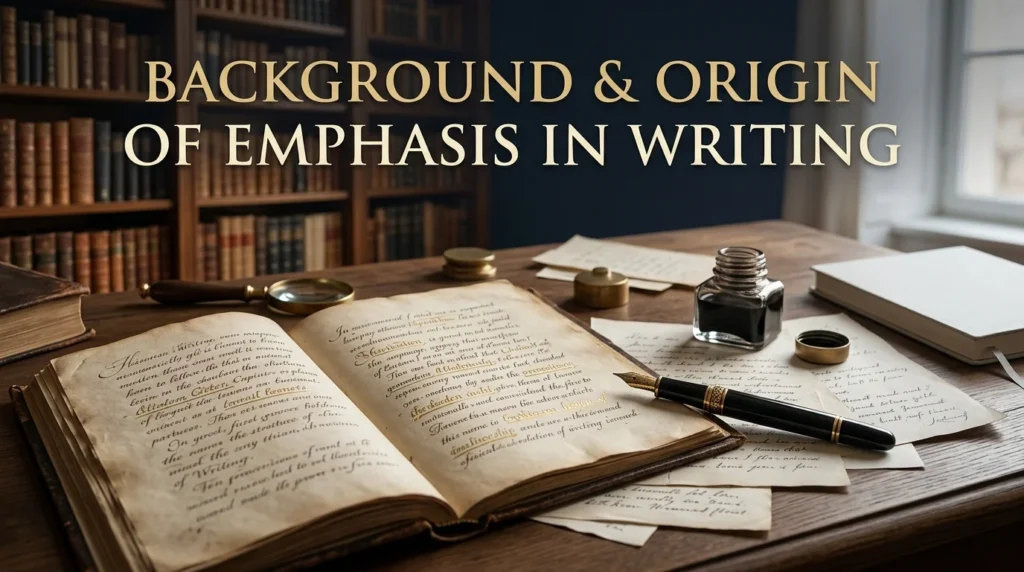
The concept of emphasis is much older than texting or social media. Writers have always used different techniques to make certain words or ideas stand out.
Before digital communication, emphasis could be created through handwriting, punctuation, typography, capitalization, underlining, or changes in letter style. Printed books also developed various typographic methods for directing a reader’s attention.
With the development of computers and word-processing software, writers gained more convenient formatting options. Bold, italic, underline, font size, highlighting, and different typefaces became common tools.
The rise of texting and social media changed how people use these techniques.
Traditional written communication often follows formal formatting rules. Online conversations are much more flexible. People may use bold words, emojis, repeated punctuation, capitalization, or unusual spacing to communicate emotion quickly.
For example:
“Wait… WHAT?!”
The emphasis here communicates surprise or disbelief.
In modern online communication, emphasis therefore serves both a visual and emotional purpose.
Usage in Different Contexts
The emphasized meaning in text can change depending on where and how the text is used. A bold word in a professional email may simply indicate an important deadline, while the same formatting in a personal conversation may add emotional intensity.
Texting and Chat Messages
Friends frequently emphasize words to make their meaning clearer.
For example:
“I literally told you yesterday 😂”
The emphasis may communicate frustration, surprise, or playful exaggeration.
Another example:
“Please call me NOW.”
Here, capitalization suggests urgency.
In casual texting, emphasis can also be playful:
“That movie was sooooo good!”
The stretched spelling creates emotional intensity.
Social Media
Social media users frequently emphasize words to attract attention.
A post might say:
“This is exactly what I needed today.”
The emphasized word tells readers where the writer’s strongest focus lies.
Creators may also use capitalization and formatting in captions, comments, and posts to make a particular phrase stand out.
For example:
“You NEED to see this.”
The capitalized word creates visual emphasis and can make the statement feel more urgent.
Professional Communication
In professional settings, emphasis usually has a more controlled purpose.
For example:
“Please submit the report by Friday.”
The bold formatting helps the reader notice the deadline.
However, excessive capitalization can appear aggressive or unprofessional:
“SEND THIS TO ME NOW.”
A more professional version would be:
“Please send this to me as soon as possible.”
The meaning is still clear, but the tone is less forceful.
Academic Writing
Academic writers may use emphasis carefully to draw attention to a key concept or distinction.
For example:
The study focuses specifically on long-term effects.
Here, the emphasis signals that “specifically” is important to understanding the statement.
Platform-Specific Meanings of Emphasized Text
Different platforms provide different formatting tools, but the basic purpose of emphasis remains similar.
| Platform | Common Use of Emphasis | Example |
| Bold, italics, strikethrough | “Please come today.” | |
| Capitalization, spacing, emojis, caption styling | “This is everything!” | |
| TikTok | Captions and capitalization | “You NEED to see this.” |
| Snapchat | Text styling and capitalization | “I’m serious 😂” |
| Twitter/X | Capitalization, punctuation, emojis | “THIS is the point.” |
The exact formatting options can vary by platform and interface, but emphasis generally signals that a particular part of the message deserves additional attention.
Other Fields Using the Word “Emphasized”
The word emphasized is not limited to texting. It appears across many areas of communication.
Education
Teachers may emphasize important concepts during lessons.
Example:
“The teacher emphasized the importance of regular practice.”
Here, emphasized means gave special attention to.
Business
A manager might emphasize a deadline during a meeting.
Example:
“The manager emphasized that the project must be completed on time.”
The word does not mean that the manager necessarily used bold formatting. It means the point received special attention.
Writing and Publishing
Editors can emphasize particular words through typography.
Examples include:
- Bold
- Italic
- Underlining
- CAPITALIZATION
- Highlighting
- Different font sizes
Public Speaking
Emphasis can also be vocal rather than visual.
A speaker might stress one word:
“We need this today.”
The speaker’s voice makes “today” more prominent.
Marketing
Advertisers frequently emphasize important benefits:
“Get FREE delivery today!”
The emphasis is intended to attract attention to a particular selling point.
Common Misconceptions & Mistakes
People sometimes assume that emphasized text always has the same emotional meaning. It does not.
The meaning depends heavily on the context, relationship between the people, and surrounding words.
Mistake 1: Assuming Bold Means Anger
Bold text does not automatically mean that someone is angry.
For example:
“Meeting starts at 9 AM.”
The bold text may simply identify an important time.
Mistake 2: Thinking Capital Letters Always Mean Shouting
Capital letters can sometimes represent shouting online, but they can also simply be used for emphasis.
Compare:
“I AM SO EXCITED!”
with:
“Please bring your ID BEFORE entering.”
The first may express excitement, while the second may highlight an important requirement.
Mistake 3: Confusing Emphasis With a New Meaning
Emphasis normally changes focus or tone, not the dictionary meaning of a word.
For example:
“I really like it.”
The word “really” still has its normal meaning. Its formatting simply gives it additional attention.
Mistake 4: Overusing Formatting
If every word is bold, nothing stands out.
For example:
Please send the file today.
Excessive emphasis can make a message difficult to read and may appear overly aggressive.
Similar Terms & Alternatives
Several words can describe the idea behind emphasized text.
| Term | Meaning | Example |
| Highlighted | Made noticeable | “The deadline was highlighted.” |
| Stressed | Given special importance | “She stressed the deadline.” |
| Underlined | Marked with a line | “The important phrase was underlined.” |
| Bolded | Made visually heavier | “The heading was bolded.” |
| Accentuated | Made more noticeable | “The design accentuated the title.” |
| Reinforced | Made an idea stronger | “The example reinforced the point.” |
| Focused on | Given attention | “The discussion focused on the problem.” |
These terms overlap, but they are not always interchangeable.
For example, bolded specifically describes formatting, while emphasized can describe either formatting or the act of giving something greater importance.
How to Respond to Emphasized Text Chat Examples
Sometimes the emphasis itself tells you what the sender wants you to notice.
Conversation With a Friend
Friend: “Please DON’T forget my charger!”
You: “Haha, I got it 😄 I definitely won’t forget.”
Here, the capitalization shows that remembering the charger is important.
Conversation With a Crush
Crush: “You looked really good today.”
You: “Really? 😊 Thank you!”
The italicized word adds extra attention to the compliment.
The emphasis could suggest sincerity or stronger emotional expression, although the exact intention depends on the relationship and context.
Conversation With a Colleague
Colleague: “The client meeting is at 10 AM tomorrow.”
You: “Got it. I’ll be ready before 10.”
In this case, the bold formatting is practical rather than emotional. It highlights an important schedule detail.
Differences From Similar Words
The emphasized meaning in text is sometimes confused with words such as secret, private, confidential, highlighted, or urgent. These terms can overlap in certain situations, but they describe different concepts.
Emphasized vs. Secret
Emphasized means something receives extra attention.
Secret means information is intentionally kept unknown from others.
Example:
“The word important was emphasized.”
versus:
“The information was kept secret.”
Something can be emphasized without being secret.
Emphasized vs. Private
Private refers to information intended for a limited audience.
Example:
“This is a private conversation.”
Emphasis does not determine who can see information.
Emphasized vs. Confidential
Confidential means information should generally be protected from unauthorized disclosure.
Example:
“This document contains confidential information.”
A confidential word could be emphasized, but the two concepts are different.
Emphasized vs. Highlighted
These words are often very close.
If someone says:
“I emphasized the deadline.”
they mean they gave the deadline special attention.
If someone says:
“I highlighted the deadline.”
they may mean they literally marked it visually or simply drew attention to it.
Emphasized vs. Urgent
Something emphasized is not necessarily urgent.
For example:
“The meeting location is Room 5.”
The location is emphasized, but the meeting may not be urgent.
Relevance in Online Conversations and Dating Apps
The way people emphasize words can be particularly noticeable in casual conversations and dating apps.
When communication happens mainly through text, people lose many nonverbal signals such as facial expressions, gestures, and vocal tone. Formatting can partially replace those signals.
For example:
“I like you.”
This is straightforward.
Compare:
“I really like you.”
The second version places more focus on “really.”
Another example:
“You are actually funny 😂”
Depending on the conversation, emphasis on “actually” could make the statement playful, teasing, or surprisingly sincere.
However, it is important not to treat formatting as a guaranteed sign of romantic interest.
A person may emphasize a word simply because they want clarity or because that is their normal texting style.
Emphasis in Dating Messages
Consider:
“I really want to see you again.”
The emphasized word may strengthen the statement, but its exact emotional significance should be understood from the entire conversation rather than formatting alone.
Similarly:
“You looked amazing tonight.”
The bold word draws attention to the compliment.
The surrounding conversation, relationship, and communication style provide important context.
Why Context Matters When Reading Emphasized Text
One of the most important rules for understanding emphasized text is to read the whole sentence.
Consider:
“I said I was fine.”
The italicized “fine” could simply add stress, but depending on the surrounding conversation, it might also suggest that the speaker is not actually fine.
Now compare:
“The answer is fine.”
Here, “fine” may simply be highlighted for clarity.
Formatting alone cannot reliably determine someone’s intention.
Pay attention to:
- The words surrounding the emphasis
- Previous messages
- Punctuation
- Emojis
- The relationship between the people
- The platform being used
- The person’s usual writing style
These clues provide a more accurate interpretation.
Popularity & Trends Over Time
Emphasized text has become increasingly important as digital communication has grown.
People now communicate through messaging apps, social platforms, workplace chats, comments, emails, online forums, and dating applications. Because many of these interactions are text-based, writers use formatting and visual signals to make their intended focus clearer.
Social media culture has also encouraged creative forms of emphasis.
Examples include:
- ALL CAPS
- Repeated letters
- Multiple exclamation marks
- Bold words
- Italicized words
- Emojis
- Line breaks
- Repeated phrases
Meme culture has made unusual capitalization and exaggerated formatting especially recognizable.
For example:
“I CANNOT believe this 😭”
The capitalization and emoji together create a stronger emotional impression than the plain sentence:
“I cannot believe this.”
Google searches around terms such as “emphasized meaning,” “bold text meaning,” and “what does emphasized mean in texting” also reflect the broader curiosity people have about digital communication styles. Search interest can change over time, however, so specific trend levels should be checked for the relevant date and region rather than assumed to be permanent.
Frequently Asked Questions
1. What is the emphasized meaning in text?
The emphasized meaning in text refers to giving a word, phrase, or idea extra attention or importance. This can be done through bold text, italics, capitalization, punctuation, or other formatting.
2. Does emphasized text mean someone is angry?
Not necessarily. Emphasized text can indicate importance, excitement, urgency, surprise, humor, or simply clarity. You should consider the complete message before interpreting its emotional meaning.
3. What does bold text mean in a message?
Bold text usually means that the sender wants a particular word or phrase to stand out. It may indicate importance, but it does not automatically indicate anger or romantic interest.
4. Is emphasized the same as highlighted?
They can have similar meanings, but they are not always identical. Emphasized means given extra attention or importance, while highlighted can specifically refer to visually marking something.
5. Can emphasis change the meaning of a sentence?
Emphasis can change the tone, focus, or interpretation of a sentence without necessarily changing the dictionary meaning of the words. For example, emphasizing “really” can make a statement sound stronger.
6. Why do people emphasize words in texting?
People emphasize words to make their intended focus clearer, communicate emotion, show urgency, add humor, or make an important detail easier to notice.
7. Does emphasis have the same meaning on every social media platform?
Not always. The basic idea is similar, but formatting tools and communication conventions differ between platforms. Context is important when interpreting emphasized text.
Conclusion
The emphasized meaning in text is connected with giving extra attention, importance, or stress to a particular word or idea. In digital conversations, emphasis can appear through bold text, italics, capitalization, punctuation, emojis, repeated letters, and other visual techniques.
The meaning of emphasis depends heavily on context. A bold word in a professional email may simply identify an important deadline, while the same kind of emphasis in a personal conversation may add emotion or playfulness.
Most importantly, emphasized text should not be interpreted in isolation. Look at the complete sentence, surrounding messages, relationship, platform, and communication style before deciding what the sender means. When you understand these signals together, it becomes much easier to read online conversations accurately and avoid unnecessary misunderstandings.

Daniel Harper is a passionate content writer and language enthusiast who specializes in explaining modern text meanings, slang, and digital communication in a simple and clear way. He enjoys breaking down complex expressions into easy-to-understand insights so readers can quickly learn and use them in real life. He is dedicated to creating helpful content that improves understanding of everyday language trends and online communication.