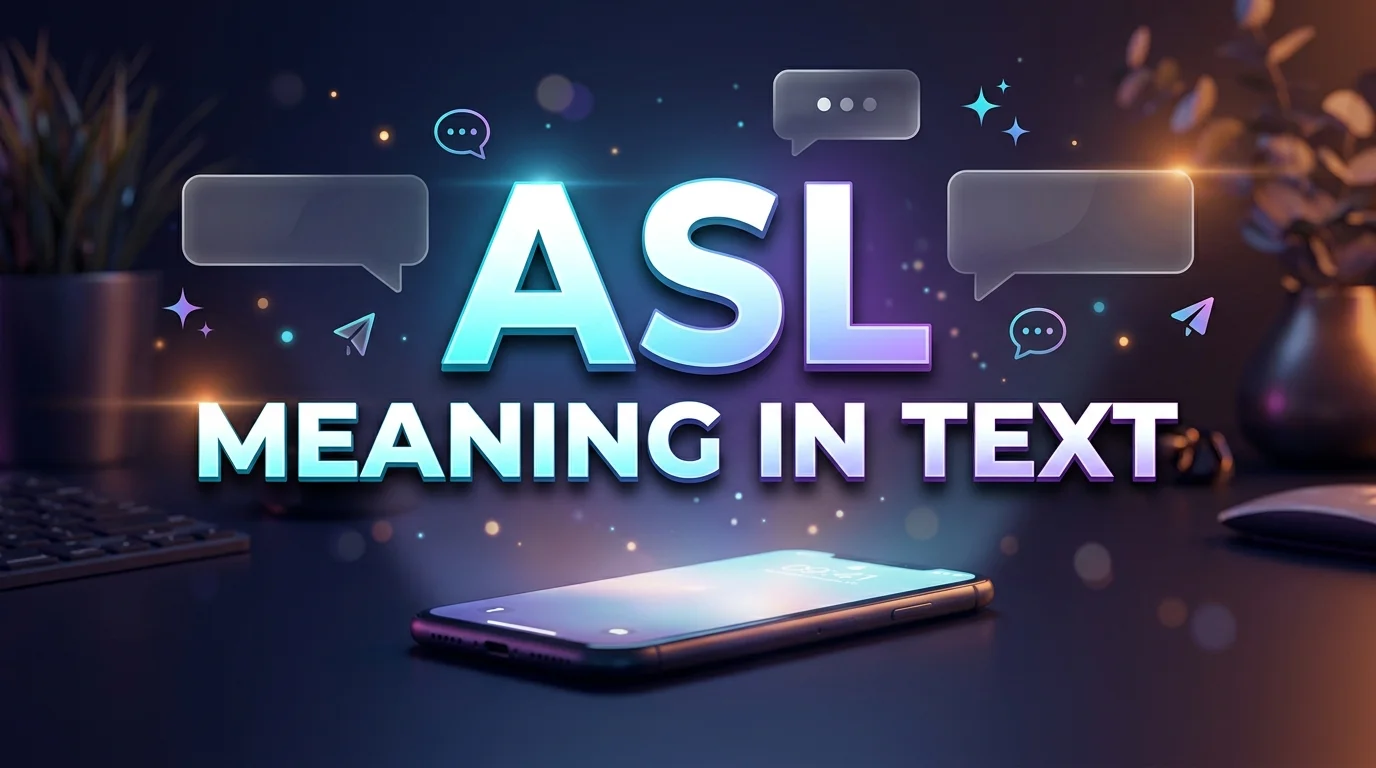
Looking for the ASL Meaning in Text because you received this short abbreviation in a chat or social media message? ASL is a common texting term that can have different meanings depending on the conversation and context.
Many people see ASL for the first time and wonder whether it is asking a question or referring to something else. In casual online conversations, ASL has traditionally been used to ask about a person’s age, sex, and location. However, its meaning can vary across different platforms, communities, and situations.
Understanding the context can help you know exactly what someone means when they use ASL. In this guide, we will explain the ASL Meaning in Text, its common uses, examples, and how to respond when someone sends it to you.
Meaning & Definition of ASL in Text
The meaning of ASL changes according to the context in which it appears.
In older internet chat culture, ASL commonly meant “Age, Sex, Location.” People used it to quickly ask another person about their age, gender, and general location.
For example:
Person A: Hey, ASL?
Person B: 24, female, Texas.
This use became particularly common in chat rooms and instant messaging during the early days of online social interaction.
However, ASL has another very important meaning: American Sign Language. When people are discussing communication, deaf communities, accessibility, interpreting, or sign language, ASL almost always refers to American Sign Language.
For example:
“I’m learning ASL because I want to communicate with more people.”
There is also a slang use of ASL meaning “as hell.” In this form, it usually appears after an adjective to add emphasis.
For example:
“That movie was funny asl 😂”
Here, asl means “funny as hell,” or simply “extremely funny.”
Quick Meaning Guide
| ASL Meaning | Where It Is Common | Example |
| Age, Sex, Location | Old chat rooms and online conversations | “ASL?” |
| American Sign Language | Education, accessibility, communication | “Do you know ASL?” |
| As hell | Casual texting and social media | “That’s cold asl.” |
Because these meanings are very different, reading the complete message is important before deciding what ASL means.
Background & Origin of ASL
The abbreviation ASL has been used online for many years, especially in early chat rooms and instant messaging.
During the early internet era, users often wanted to learn basic information about people they were chatting with. Instead of typing “How old are you? Are you male or female? Where are you from?” users could simply type ASL?
This made online conversations faster and helped establish ASL as a recognizable chat abbreviation.
The popularity of this meaning increased through chat rooms, instant messaging services, and early social networking communities. Although the “age, sex, location” meaning is much less dominant today, people may still recognize it because of its connection with early internet culture.
The meaning American Sign Language has a completely different history. It refers to a natural visual language used primarily by Deaf and partially deaf communities in the United States and parts of Canada.
More recently, lowercase asl has also become common as a slang intensifier meaning “as hell.” Social media, memes, gaming communities, and casual messaging have helped spread this usage.
So, the abbreviation has developed several meanings over different periods of internet culture.
Usage of ASL in Different Contexts
ASL in Texting or Chat Messages
In casual messages, ASL can have more than one interpretation.
If someone simply sends:
“ASL?”
they may be using the traditional meaning “age, sex, location.”
However, if someone writes:
“I’m tired asl.”
the meaning is clearly “tired as hell.”
The difference comes from sentence structure.
A standalone ASL? can suggest a question about age, sex, and location, while lowercase asl after an adjective usually works as an intensifier.
ASL on Social Media
On platforms such as Instagram, TikTok, Snapchat, and X, asl is often used as casual slang.
For example:
“This song is good asl 🔥”
The person means that the song is extremely good.
Another example is:
“Bro is fast asl.”
This means the person is extremely fast.
On social media, context and writing style are especially important. Lowercase asl often signals informal slang rather than the older chat-room question.
ASL in Professional or Educational Settings
In professional, educational, medical-accessibility, or communication-related discussions, ASL commonly means American Sign Language.
Examples include:
“The school offers introductory ASL classes.”
“We need an ASL interpreter for the event.”
In these situations, interpreting ASL as “as hell” would obviously be inappropriate.
The same three letters can therefore have completely different meanings depending on the setting.
Platform-Specific Meanings of ASL
| Platform | Common Meaning | Example Use |
| As hell / Age, Sex, Location | “That was funny asl.” | |
| As hell | “She looks amazing asl.” | |
| TikTok | As hell | “This trend is weird asl.” |
| Snapchat | As hell / Age, Sex, Location | “You tired asl?” |
| Twitter/X | As hell | “That comment was wild asl.” |
These are general usage patterns rather than fixed platform definitions. Users can use abbreviations differently depending on their community and conversation.
Other Fields Using the Abbreviation ASL
The meaning of ASL is not limited to texting.
American Sign Language
This is one of the most established meanings of ASL. It refers to American Sign Language, a complete natural language with its own grammar and structure.
Example:
“She has been studying ASL for two years.”
Age, Sex, Location
This meaning comes from early online chat culture.
Example:
“New here? ASL?”
It was traditionally used to request basic personal information from another chat participant.
As Hell
In informal internet slang, asl can mean “as hell.”
Example:
“That game is hard asl.”
Here, the abbreviation emphasizes the word “hard.”
Advanced Surface Layer
In some technical contexts, abbreviations can have specialized meanings that depend on a particular organization, software system, or industry.
Because technical abbreviations are not always standardized, readers should check the surrounding documentation before assigning a meaning to ASL.
Aviation, Science, and Other Specialized Uses
ASL may also appear as an abbreviation in specialized fields. Its exact expansion can differ according to the industry, document, or organization.
This is why a dictionary-style assumption is not always enough. The sentence surrounding the abbreviation usually provides the strongest clue.
Common Misconceptions & Mistakes About ASL
One common mistake is assuming that ASL always means “age, sex, location.”
That interpretation was especially common in older internet chat environments, but modern users frequently use asl to mean “as hell.”
Another common mistake is confusing the slang meaning with American Sign Language.
Consider these two examples:
“I’m learning ASL.”
“This is difficult asl.”
The first refers to American Sign Language. The second uses internet slang to mean “difficult as hell.”
ASL Does Not Have One Universal Meaning
There is no single interpretation that works for every conversation.
You should consider:
- The words before and after ASL
- Whether it is uppercase or lowercase
- The platform being used
- The topic of the conversation
- Whether the conversation is casual or professional
- The age and online community of the people communicating
Be Careful With “Age, Sex, Location”
If someone asks “ASL?”, they may be asking for personal information.
You do not have to provide personal details simply because someone asks. If the conversation feels uncomfortable, you can ask what they mean or avoid sharing information.
Similar Terms & Alternatives
Different abbreviations and phrases can sometimes appear in conversations where ASL is used.
| Term | Meaning | Example |
| A/S/L | Age, Sex, Location | “A/S/L?” |
| Age? | Asking someone’s age | “Age?” |
| Location? | Asking where someone is | “What’s your location?” |
| ASL | American Sign Language | “Do you know ASL?” |
| asl | As hell | “That’s funny asl.” |
| OMG | Oh my God | “OMG, that’s wild!” |
| AF | Very/extremely, often vulgar emphasis | “That’s cool AF.” |
| FR | For real | “That was scary, FR.” |
| IDK | I don’t know | “IDK what happened.” |
The important difference is that ASL has multiple unrelated meanings, while many common texting abbreviations have one dominant informal interpretation.
How to Respond to ASL Chat Examples
Knowing what ASL means is useful, but knowing how to respond naturally is just as important.
Conversation 1: Friend
Friend: This homework is hard asl 😭
You: Seriously! I’ve been stuck on the same question for 20 minutes.
Here, asl means “as hell.”
Conversation 2: Online Chat
Person: ASL?
You: What do you mean by ASL?
This is a safe and simple response when the abbreviation is unclear.
If the person means “age, sex, location,” they can explain what information they are asking for.
Conversation 3: Colleague
Colleague: Do you know ASL?
You: Do you mean American Sign Language?
Colleague: Yes. We’re arranging an accessibility workshop.
In this professional context, ASL clearly refers to American Sign Language.
Differences Between ASL and Similar Words
Because ASL has multiple meanings, it is useful to compare its slang usage with words that express similar ideas.
ASL vs. Very
When asl means “as hell,” it can intensify an adjective.
“I’m tired asl.”
This is similar to:
“I’m extremely tired.”
However, asl is much more informal.
ASL vs. Extremely
“Extremely” is appropriate in formal writing.
“The weather is extremely hot.”
“Asl” is generally associated with casual online communication.
“It’s hot asl.”
The second sentence would normally be unsuitable for a formal report or business document.
ASL vs. Secret
Secret means something intentionally kept from others.
ASL does not mean secret.
For example:
“Keep this secret.”
is completely different from:
“That test was hard asl.”
ASL vs. Private
Private refers to something not intended for public access or discussion.
It does not mean ASL.
If someone asks “ASL?” using the traditional chat meaning, they may be requesting personal information, but the abbreviation itself does not mean “private.”
ASL vs. Confidential
Confidential usually describes information that should not be disclosed to unauthorized people.
Again, this is unrelated to the common texting meanings of ASL.
Understanding these distinctions prevents incorrect interpretations.
ASL in Online Conversations & Dating Apps
Abbreviations can have an interesting role in online dating and casual conversations.
If someone sends:
“ASL?”
they may be using the older age, sex, location meaning to learn basic information about the person they are talking to.
However, the same abbreviation can appear in a completely different way:
“You’re funny asl 😂”
In that sentence, asl means “as hell.”
Dating-app conversations are often fast and informal, so abbreviations are common. A person may use slang to make their messages shorter, more relaxed, or humorous.
Example on a Dating App
Match: Your profile is cute asl 😂
You: Haha thank you!
Here, asl is being used as an intensifier.
But if someone says:
“ASL?”
it is better to look at the surrounding conversation before assuming what they mean.
If the meaning is unclear, simply asking “What do you mean by ASL?” can prevent an awkward misunderstanding.
Why Context Matters So Much With ASL
The biggest lesson when interpreting ASL is that context matters.
Compare these three sentences:
“Do you speak ASL?”
“That dog is cute asl.”
“ASL?”
The first almost certainly refers to American Sign Language.
The second uses asl as slang for “as hell.”
The third may refer to “age, sex, location.”
The letters have not changed, but the meaning has.
This is common with internet abbreviations because users often create shortened forms that depend heavily on sentence structure and community habits.
Popularity & Trends Over Time
The popularity of different ASL meanings has changed as online communication has evolved.
During early chat-room culture, ASL was strongly associated with “age, sex, location.” Users often relied on short abbreviations because instant messaging encouraged quick exchanges.
As social media and smartphones became more popular, slang developed differently. Lowercase asl became increasingly recognizable as an informal intensifier meaning “as hell.”
Meanwhile, ASL as American Sign Language has remained an established abbreviation in education, accessibility, communication, and Deaf-community contexts.
Search interest around abbreviations can also fluctuate as slang becomes popular through memes, viral posts, gaming communities, and short-form video platforms. However, search trends alone do not establish one universal meaning because different communities may use the abbreviation differently.
Common ASL Texting Examples
Here are several examples that make the different meanings easier to recognize:
As hell:
“That was funny asl 😂”
“I’m hungry asl.”
“This game is difficult asl.”
American Sign Language:
“I’m taking an ASL class.”
“She communicates using ASL.”
Age, Sex, Location:
“Hey, ASL?”
“The person in the chat asked for my ASL.”
Looking at the sentence structure is usually enough to identify the intended meaning.
Tips for Understanding ASL Correctly
When you see ASL in a message, do not immediately assume its meaning.
Instead, follow these simple steps:
- Read the complete sentence.
- Look at the words surrounding ASL.
- Check whether it is uppercase or lowercase.
- Consider the platform and community.
- Think about whether the conversation is casual or professional.
- Ask for clarification if the meaning remains unclear.
For example, “That movie was scary asl” strongly suggests “as hell,” while “I am studying ASL” strongly suggests American Sign Language.
Related Text Abbreviations
If you are learning online slang, you may also encounter abbreviations such as FR, IDK, OMG, LOL, BRB, and DM.
Learning these terms together can make texting conversations much easier to understand.
For example:
“FR, that movie was scary asl.”
Here, FR means “for real,” while asl means “as hell.”
Another example:
“IDK why I’m tired asl today.”
Here, IDK means “I don’t know,” and asl means “as hell.”
This shows why understanding individual abbreviations and their surrounding context is important.
FAQs About ASL in Text Meaning
What does ASL mean in text?
In text messages, ASL can mean several things. Common meanings include “age, sex, location,” “American Sign Language,” and slang “as hell.” The surrounding sentence determines the intended meaning.
What does asl mean on social media?
On social media, lowercase asl commonly means “as hell” when it follows an adjective. For example, “That video is funny asl” means the video is extremely funny.
Does ASL mean American Sign Language?
Yes. ASL commonly stands for American Sign Language, especially in educational, accessibility, communication, and Deaf-community contexts.
What does “ASL?” mean in an old chat?
In older internet chat culture, “ASL?” commonly meant “age, sex, location?” It was a quick way for someone to ask for basic personal information.
Is ASL appropriate in professional messages?
It depends on the meaning. ASL is perfectly appropriate when discussing American Sign Language, but the slang meaning “as hell” is generally too informal for professional communication.
How can I tell which ASL meaning someone intends?
Look at the context. If ASL relates to language or accessibility, it likely means American Sign Language. If it follows an adjective, it may mean “as hell.”
Is ASL still used to mean age, sex, location?
Yes, people may still recognize or use it in some online conversations, but this meaning is strongly associated with older internet chat culture. Modern users may also interpret asl as “as hell.”
Conclusion
The asl in text meaning depends heavily on context. The abbreviation can refer to “age, sex, location,” “American Sign Language,” or the casual slang phrase “as hell.” In modern social-media conversations, lowercase asl is often used as an intensifier, while ASL in educational or accessibility settings commonly refers to American Sign Language.
The older “age, sex, location” meaning may still appear, particularly in nostalgic or old-style online chat situations. Whenever you see ASL in a message, read the surrounding words and consider the conversation before deciding what it means.

I am William Scott, a passionate content creator and enthusiast dedicated to making complex topics simple and easy to understand. I focus on delivering valuable, well-researched, and engaging content that helps readers find clear answers quickly. I enjoy writing about digital trends, language meanings, and practical knowledge that adds real value to everyday learning.