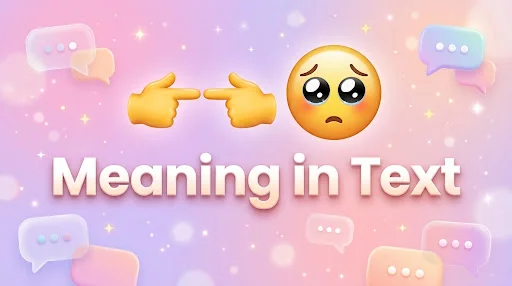
Looking for the 👉👈🥺 meaning in text? These cute emojis are often used in texting, social media chats, and online conversations to express shyness, nervousness, or a sweet and innocent feeling.
When someone sends 👉👈🥺, they may be trying to ask for something politely, show affection, or make a request in a cute and playful way. The 👉👈 emojis usually represent shy finger-pointing, while 🥺 adds a pleading or puppy-eyed expression.
Together, these emojis can make a message sound more adorable, emotional, or flirtatious, depending on the situation. You might see them on TikTok, Instagram, Snapchat, or in a private message from a friend or crush. In this guide, you will discover what 👉👈🥺 means in text, how people use it in different conversations, and how to understand its meaning when someone sends it to you.
Meaning & Definition
The 👉👈🥺 meaning in text usually expresses shyness, embarrassment, hesitation, cuteness, or a timid request.
The two pointing fingers 👉👈 visually suggest someone nervously bringing their fingers together or fidgeting with them. The pleading face 🥺 adds an emotional expression that can suggest vulnerability, innocence, begging, or wanting affection.
When these emojis appear together, the sender is often trying to create a shy, soft, cute, or pleading tone.
For example:
“Can you stay a little longer? 👉👈🥺”
Here, the person is making a request in a shy or affectionate way.
Another example is:
“I kinda missed you 👉👈🥺”
In this situation, the emojis can make the statement feel more vulnerable and less direct.
What Does 👉👈 Mean?
The 👉👈 combination is commonly associated with shyness, nervousness, awkwardness, hesitation, or feeling bashful.
It can represent the imaginary movement of someone touching or rubbing their index fingers together because they feel shy.
For example:
“I wanted to ask you something 👉👈”
The emojis suggest that the person may feel nervous about asking.
What Does 🥺 Mean?
The 🥺 emoji is officially known as the pleading face. In online conversations, it can communicate several related emotions, including:
- Pleading
- Wanting something
- Sadness
- Vulnerability
- Innocence
- Cuteness
- Affection
- Emotional appeal
Its meaning changes depending on the surrounding words.
For example:
“Please don’t go 🥺”
Here, it expresses pleading or sadness.
But:
“You look so cute today 🥺”
can communicate affection or admiration.
What Does 👉👈🥺 Mean Together?
When 👉👈 and 🥺 are combined, the overall message often becomes something like:
“I’m shy to ask.”
“Please?”
“I’m feeling embarrassed.”
“I want your attention.”
“I’m being cute and shy.”
“I really hope you’ll say yes.”
The combination does not have one fixed dictionary definition. Instead, it creates an emotional tone.
Background & Origin
Unlike abbreviations such as LOL, BRB, or IDK, 👉👈🥺 does not come from a shortened phrase. It developed from the way internet users combine visual symbols to communicate emotions.
Emoji communication became increasingly common as smartphones, social media, messaging applications, and online communities expanded. Instead of typing a long emotional explanation, users could select a few emojis and allow the visual combination to communicate the mood.
The 👉👈 gesture became associated with shyness and nervousness because of the way the two pointing fingers appear to interact. The 🥺 emoji later became widely used for pleading, vulnerability, affection, and exaggerated cuteness.
Together, they became especially useful in casual internet communication.
The combination is also connected to the broader internet culture of using exaggerated expressions to make messages feel more playful. Someone who could simply write “please” might add 🥺, while someone who wants to sound especially shy might add 👉👈🥺.
Over time, the combination became recognizable across many social platforms.
Usage in Different Contexts
The meaning of 👉👈🥺 can change depending on where you see it. The same emoji combination can be innocent between friends, affectionate in a romantic conversation, or playful in a social media comment.
In Texting and Chat Messages
In private messages, 👉👈🥺 is often used to soften a request.
For example:
“Can you send me that picture 👉👈🥺”
The sender is probably trying to make the request sound cute or less demanding.
Another example:
“Can I call you tonight 👉👈🥺”
Here, the combination can communicate nervousness or affection.
It can also be used after saying something embarrassing:
“Okay, I actually like that song 👉👈🥺”
The emojis make the confession sound shy and playful.
On Instagram
Instagram users frequently use emojis in comments, captions, Stories, and direct messages.
For example:
“You look amazing 👉👈🥺”
This can express admiration with a shy or affectionate tone.
A person might also comment:
“Can I get one too 👉👈🥺”
Here, the combination makes the request playful rather than demanding.
On TikTok
TikTok culture often relies on exaggerated emotional expressions. 👉👈🥺 can therefore be used humorously, romantically, or ironically.
For example:
“Me asking for another episode 👉👈🥺”
The combination makes the request intentionally dramatic and cute.
It can also appear in comments when someone wants to compliment a creator:
“That outfit though 👉👈🥺”
The exact tone depends on the video and surrounding conversation.
On Snapchat
On Snapchat, the combination may appear in direct messages or captions.
For example:
“Don’t leave me on delivered 👉👈🥺”
This could be a playful way of asking someone to respond.
Friends may also use it jokingly when requesting something:
“Save me some fries 👉👈🥺”
In Professional or Technical Settings
👉👈🥺 is generally not appropriate for formal professional communication.
You would normally avoid using it in business emails, official reports, academic writing, workplace documentation, or technical instructions.
For example, instead of writing:
“Could you review this document 👉👈🥺”
in a formal email, a professional writer would simply say:
“Could you please review this document?”
The emoji combination belongs primarily to informal digital communication.
Platform-Specific Meanings
| Platform | Common Meaning | Example Use |
| Shyness, pleading, affection, cute request | “Can you call me 👉👈🥺” | |
| Admiration, flirting, playful requests | “You look so good 👉👈🥺” | |
| TikTok | Humor, exaggerated shyness, pleading | “Me asking for part two 👉👈🥺” |
| Snapchat | Nervousness, affection, playful requests | “Don’t forget me 👉👈🥺” |
| Twitter/X | Humor, vulnerability, playful pleading | “Someone please explain this 👉👈🥺” |
These meanings are not official platform definitions. They describe common ways people may interpret the emoji combination in casual online communication.
Other Fields Using the Emoji Combination
The combination 👉👈🥺 does not have a standard technical, medical, scientific, or professional abbreviation meaning.
This is an important distinction.
Traditional abbreviations can have specialized meanings in different fields. For example, DM can mean “direct message” online but may have other meanings in professional contexts. ETA can mean “estimated time of arrival,” while other fields may use the same letters differently.
That is not generally the case with 👉👈🥺.
Its primary role is emotional communication.
Still, you may encounter the combination in different online communities.
Gaming Communities
A gamer might write:
“Can you carry me this round 👉👈🥺”
The emojis make the request playful.
Fan Communities
Someone might comment:
“Please give us another update 👉👈🥺”
Here, the combination adds an affectionate or pleading tone.
Meme Culture
Memes often use 👉👈🥺 to exaggerate a request or create a deliberately cute personality.
For example:
“Me asking for one more slice of pizza 👉👈🥺”
The humor comes from making an ordinary request sound overly shy and dramatic.
Common Misconceptions & Mistakes
Because emojis are highly contextual, people sometimes misunderstand 👉👈🥺.
It Does Not Always Mean Flirting
One common mistake is assuming that 👉👈🥺 automatically means romantic interest.
It can certainly be used while flirting, but friends can also use it jokingly.
For example:
“Bro, give me the last cookie 👉👈🥺”
There is no romantic meaning here. The sender is simply making a playful request.
It Does Not Always Mean Sadness
The 🥺 emoji can look sad, but the combination does not necessarily mean that someone is genuinely upset.
A person may use it dramatically for humor:
“Please give me five more minutes 👉👈🥺”
The sender may simply be joking.
It Is Not an Abbreviation
Another misconception is treating 👉👈🥺 like a shortened phrase such as LOL or BTW.
It is better described as an emoji combination.
Its meaning comes from the emotional associations of the individual emojis and the context in which they appear.
Context Matters
Consider these two messages:
“I really want to see you 👉👈🥺”
and:
“Can you send the homework 👉👈🥺”
The first may sound romantic or emotionally vulnerable.
The second is more likely to be a playful request between friends or classmates.
Similar Terms & Alternatives
Several emojis and expressions can communicate a similar feeling.
| Term or Emoji | Meaning | Example |
| 🥺 | Pleading, vulnerability, cuteness | “Please stay 🥺” |
| 👉👈 | Shyness or nervousness | “I have a question 👉👈” |
| 🥹 | Emotional or touched | “You remembered 🥹” |
| 🥰 | Affection or love | “That’s so sweet 🥰” |
| 😳 | Embarrassment or surprise | “You actually said that 😳” |
| 👉👈 | Hesitation | “I kinda want one 👉👈” |
| “Please?” | Direct but soft request | “Can I come too, please?” |
| “Pretty please?” | Playful pleading | “Pretty please?” |
The choice depends on how strong or specific you want the emotional tone to be.
How to Respond Chat Examples
Knowing the meaning is useful, but you may still wonder how to respond when someone sends 👉👈🥺.
Conversation With a Friend
Friend:
“Can you bring me something to eat 👉👈🥺”
You:
“Lol sure 😂 What do you want?”
Here, the emojis are simply making the request playful.
Conversation With a Crush
Crush:
“I kinda wanna see you tonight 👉👈🥺”
You:
“You could’ve just asked 😄”
In a romantic conversation, the combination may communicate shyness or hesitation.
Conversation With a Colleague
Colleague:
“Could you send me the file again 👉👈🥺”
You:
“Sure, sending it now.”
In this context, the emoji makes a simple request feel more casual and friendly.
Differences from Similar Words
The emotional meaning of 👉👈🥺 can overlap with words such as “shy,” “private,” “sorry,” “please,” and “cute,” but these are not exact equivalents.
👉👈🥺 vs. Shy
Shy directly describes a person’s emotional or social behavior.
👉👈🥺 can visually communicate shyness without actually stating the word.
Example:
“I’m too shy to ask 👉👈🥺”
The words explain the feeling, while the emojis reinforce it.
👉👈🥺 vs. Please
“Please” is a request word.
👉👈🥺 can make a request sound softer, more playful, or more pleading.
Example:
“Can I have one please?”
is straightforward.
“Can I have one 👉👈🥺”
sounds more timid or cute.
👉👈🥺 vs. Sorry
The combination does not inherently mean “sorry.”
Someone may use it after making an awkward statement, but the context must indicate whether an apology is intended.
👉👈🥺 vs. Private
“Private” describes information or something intended for limited access.
👉👈🥺 does not mean private.
For example, saying:
“This is private.”
has a completely different meaning from:
“Can I tell you something 👉👈🥺”
👉👈🥺 vs. Confidential
“Confidential” generally means information should not be shared with unauthorized people.
The emoji combination has no standard relationship with confidentiality.
A message such as:
“I have a secret 👉👈🥺”
does not mean the emojis themselves mean “confidential.”
Relevance in Online Conversations & Dating Apps
The combination 👉👈🥺 can be especially noticeable in dating conversations because dating apps depend heavily on short messages and emotional signals.
Text does not include facial expressions, voice tone, gestures, or body language. Emojis help fill part of that gap.
For example:
“I want to meet you 👉👈🥺”
can feel more hesitant and emotionally vulnerable than:
“I want to meet you.”
The emojis may suggest that the person feels shy about expressing interest.
Another example is:
“Can I get your number 👉👈🥺”
This can make the request sound less forceful and more playful.
However, you should not assume that the sender is definitely flirting simply because they use the combination.
Context is essential.
Look at the surrounding conversation, the relationship between the people, and the wording of the message.
Why People Use It in Dating Conversations
Dating messages often involve uncertainty.
Someone may want to express interest without making the statement sound too serious or direct.
Using 👉👈🥺 can soften a sentence such as:
“I miss you.”
into something that feels more vulnerable:
“I kinda miss you 👉👈🥺”
It can also be used humorously to reduce awkwardness.
Popularity & Trends Over Time
Emoji combinations like 👉👈🥺 became more visible as social media and mobile messaging became major parts of everyday communication.
Their popularity is influenced by online communities, memes, short-form videos, comments, and changing internet slang.
Unlike a traditional abbreviation, an emoji combination does not have a fixed lifecycle. People can reuse the same emojis in new ways as internet culture changes.
The 🥺 emoji in particular became strongly associated with pleading, cuteness, vulnerability, and exaggerated emotional reactions. Adding 👉👈 emphasizes the idea of being shy or hesitant.
Meme culture has also helped these combinations become recognizable outside private conversations.
For example:
“Me asking for one more episode 👉👈🥺”
works as a meme because the emojis exaggerate an ordinary request.
Google searches and social media discussions can fluctuate over time, so popularity should not be treated as a permanent measure of meaning. The core interpretation remains dependent on context.
Why Context Is So Important
Emoji meanings are not always fixed.
Imagine receiving:
“Can you help me 👉👈🥺”
You might interpret it as a cute request.
Now consider:
“I really like you 👉👈🥺”
The same emojis may sound romantic or shy.
And:
“Please don’t tell anyone 👉👈🥺”
could communicate nervousness or an emotional request.
The surrounding words determine the intended message.
This is why understanding 👉👈🥺 meaning in text requires more than memorizing one definition.
The best approach is to read the entire message and consider who sent it.
Is 👉👈🥺 Flirty?
Sometimes, yes.
In a conversation between two people who are already showing romantic interest, 👉👈🥺 can make a message sound shy and flirtatious.
For example:
“I was hoping you’d text me 👉👈🥺”
could reasonably sound romantic.
However, the emojis themselves do not prove romantic intent.
Friends, siblings, classmates, creators, and online communities can all use the same combination for humor or playful requests.
Therefore, interpret it based on the complete conversation rather than the emojis alone.
Is 👉👈🥺 Cute or Sad?
It can be either, depending on context.
The 🥺 emoji often contributes a pleading or vulnerable feeling, while 👉👈 adds shyness.
Together, they frequently create a cute and timid emotional tone.
For example:
“Can I have another cookie 👉👈🥺”
is probably playful.
But:
“Please don’t leave 👉👈🥺”
may communicate genuine vulnerability.
The words surrounding the emojis provide the strongest clue.
Can 👉👈🥺 Be Used Sarcastically?
Yes.
Internet users often use emotional emojis in exaggerated or ironic ways.
For example:
“Can I have just one more assignment 👉👈🥺”
could be sarcastic if the speaker clearly does not want another assignment.
Likewise:
“Please make another three-hour meeting 👉👈🥺”
could be humorous rather than a genuine request.
Online communication frequently depends on this kind of playful exaggeration.
Is It Appropriate for Professional Messages?
Generally, 👉👈🥺 is better suited to casual communication.
It may be acceptable between coworkers who have a very informal relationship, especially in a casual workplace chat, but it is usually unnecessary in formal emails, business proposals, customer communication, academic writing, or official documents.
For professional communication, direct wording is clearer.
Instead of:
“Could you review this when you get a chance 👉👈🥺”
you could write:
“Could you please review this when you have a chance?”
The second version communicates the request without relying on an emotional signal.
Frequently Asked Questions
What does 👉👈🥺 mean in text?
👉👈🥺 usually expresses shyness, hesitation, vulnerability, cuteness, or a playful request. The exact meaning depends on the words and situation surrounding the emojis.
What does 👉👈 mean from a girl?
When someone uses 👉👈, it commonly suggests shyness, nervousness, awkwardness, or hesitation. It does not automatically indicate flirting or romantic interest.
What does 🥺 mean in texting?
🥺 is commonly used to express pleading, vulnerability, sadness, affection, cuteness, or an emotional request. Its interpretation depends on context.
Does 👉👈🥺 mean flirting?
It can have a flirty meaning when used in a romantic conversation, but it is not automatically flirtatious. Friends and other people can use it playfully or humorously.
Is 👉👈🥺 a real abbreviation?
No. 👉👈🥺 is an emoji combination rather than a traditional abbreviation. Its meaning comes from the emotional associations of the individual emojis and their context.
What should I reply to 👉👈🥺?
Your response should match the conversation. If someone is making a playful request, you can respond casually. If the conversation is romantic, a warm or playful response may fit.
Is 👉👈🥺 appropriate in professional communication?
It is generally better suited to casual online conversations. In formal professional communication, clear words are usually more appropriate than this emoji combination.
Conclusion
The 👉👈🥺 meaning in text is generally connected with shyness, hesitation, vulnerability, pleading, cuteness, or a soft request. The 👉👈 emojis can suggest nervous or bashful behavior, while 🥺 adds a pleading or emotionally vulnerable feeling. Together, they can make a message sound softer, more playful, more affectionate, or sometimes more flirtatious.
However, 👉👈🥺 does not have one universal meaning. A friend asking for food, a crush expressing interest, and a TikTok user making a joke can all use the same emoji combination for different reasons.
The best way to understand it is to consider the complete message, the relationship between the people, and the surrounding conversation. Once you understand that context, 👉👈🥺 becomes much easier to interpret in texting, social media, dating apps, and everyday online communication.

Oliver Bennett is a passionate content writer who loves turning complex topics into simple, easy-to-read articles. I focus on creating helpful, engaging, and well-researched content that delivers real value to readers. I enjoy exploring new trends in digital writing and improving website visibility through quality content.